

ATC whistleblower Interview
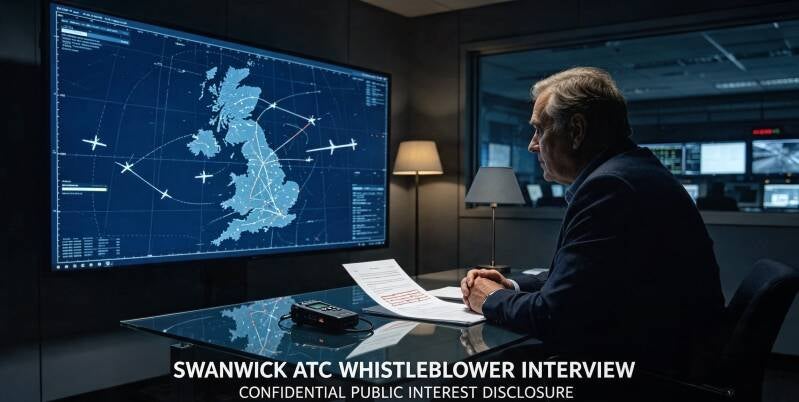
COPYRIGHT NOTICE — SWANWICK ATC WHISTLEBLOWER INTERVIEW
COPYRIGHT & PROTECTION NOTICE
© 2026 JAOC Investigations. All Rights Reserved.
This interview transcript, accompanying summary, parliamentary submission, supporting evidence, and all related materials are protected by copyright law and international intellectual property treaties. No part of this publication may be reproduced, distributed, or transmitted in any form or by any means, including photocopying, recording, or other electronic or mechanical methods, without the prior written permission of the publisher, except in the case of brief quotations embodied in critical reviews and certain other non‑commercial uses permitted by copyright law.
✅ PERMITTED USES
- Personal research & private study — single copies may be downloaded for personal, non‑commercial reference
- Fair dealing for criticism, review, or quotation — short excerpts (maximum 200 words) may be cited with clear attribution and active hyperlink to the original source
- Parliamentary & official use — submitted to UK Parliamentary Select Committees, government inquiries, and statutory regulators for the purpose of public interest scrutiny
RESTRICTED USES
- ❌ Commercial reproduction, sale, or licensing of the full or partial document
- ❌ Modification, editing, or misrepresentation of the original transcript or meaning
- ❌ Removal of attribution, copyright notice, or source protection markers
- ❌ Redistribution on third‑party platforms without written authorisation
- ❌ Use for any purpose that could identify or endanger the protected source
ATTRIBUTION GUIDELINES
When quoting or referencing this work, please cite:
Source: JAOC Investigations — Swanwick ATC Whistleblower Interview — 28 August 2026
Link: https://jaoc.org.uk/[permalink]
Copyright: © 2026 JAOC Investigations — All Rights Reserved
SOURCE PROTECTION & CONFIDENTIALITY
This document contains information obtained under conditions of strict confidentiality and public interest disclosure. Unauthorised attempts to identify, contact, or harm the source are unlawful and contrary to the Public Interest Disclosure Act 1998.
PERMISSIONS & LICENSING
For reuse requests, syndication, or full‑document licensing — contact:
JAOC Investigations — Copyright & Permissions
Email: press-jaoc@pm.me
Website: https://jaoc.org.uk
Published: 29 August 2026 | Version: 1.0
"The public has a right to know — but the public also has a duty to protect those who speak up."
SWANWICK ATC WHISTLEBLOWER INTERVIEW — FULL TRANSCRIPT
Date: Friday 28 August 2026 | Source: Retired 30‑year Radar Air Traffic Controller — Swanwick Centre
Andrew: Thank you for agreeing to meet with me. Please tell me a little about yourself without, of course, giving away your identity.
Whistleblower: I retired after a long service in Air Traffic Control which started in the 1990s.
Andrew: So clearly you have seen a lot of changes in that time?
Whistleblower: I did my training at the College of Air Traffic Control located at Bournemouth Hurn Airport. It was within old World War II buildings — which shut down around 2010–2011. It was intensive training — approximately 18 months. A lot of people failed or left. It wasn’t well paid and the pressure was immense. It almost felt like being in World War II conditions — but it also hit home the enormity of the role. It covered three core areas — Navigation, Aviation Law, and Meteorology. I chose Radar — Area rather than Approach or Aerodromes.
Andrew: Wow — I didn’t realise they go on…
Whistleblower: Yes — we used paper strips and wooden, sometimes metal, aircraft props around a board. It sounds ridiculous now — but it wouldn’t have looked out of place. While radar and procedural simulation existed, it was built on vacuum‑tube systems — nothing compared to today’s 3D simulators.
Andrew: So — when you finished training — who employed you?
Whistleblower: Right off the bat — you’d be entering a direct arm of the state. NATS was still under the Civil Aviation Authority before being privatised in 1996. You’d be packed off to a live operational unit — like the London Air Traffic Control Centre at West Drayton. You’d spend roughly a year under an experienced mentor until you could sit your validation boards and earn your rating.
Andrew: How does the modern training pipeline compare to that old‑school setup?
Whistleblower: It’s a totally different world. Trainees today enter through modern corporate pathways — specialised academies or approved providers. They spend weeks in giant‑screen 3D tower simulators and digital software — using Competency‑Based Training rather than just logging hours.
Andrew: What does a day actually look like for a controller once fully qualified?
Whistleblower: It’s intense concentration and strict routine. A shift starts with a comprehensive handover briefing — reviewing weather, restrictions, staffing, traffic flows. Then you plug into your sector — managing arrivals, departures, en‑route traffic — issuing headings, clearances, speed restrictions. You rotate off every couple of hours to decompress — the cognitive load is immense. It ends with a debrief and handover to the incoming team.
Andrew: If you specialised in radar — did that lock you into a specific path?
Whistleblower: Yes — once certified in radar, your career path was tied to radar environments. Your core rating carried over — but you still had months of local training and a brand‑new validation board for any new airspace.
Andrew: Why did they shift everything to Swanwick?
Whistleblower: Airspace is three‑dimensional and stretches far beyond any single airport. Centralising gives a seamless macro‑view across multiple regions rather than fractured local bubbles. Swanwick houses the London Area Control Centre — high‑altitude traffic across England and Wales — and the London Terminal Control Centre — coordinating arrivals and departures below 24,500 feet for all the major southern hubs.
Andrew: All this background is really helpful. So — why have you come to me?
Whistleblower: A friend of mine who spoke to you about Manchester Airport suggested you were the right person. I want to keep my name private — but if there was ever an independent inquiry, I’d come forward. I wouldn’t go to the mainstream media — it’s become the propaganda machine of government. Unless people wake up — my children, grandchildren — may not have the life they should have. What I’m about to reveal is so big — people can no longer brush it off.
Andrew: Please go ahead.
Whistleblower: Everything I tell you cannot be dismissed — look at my experience. You’ll remember the 2023 software glitch. Our systems are managed in‑house — but the software is bought in from external companies. When a critical safety system is just a commercial product — it’s built for profit, not resilience. We cannot independently audit, modify, or repair it. There’s massive supply chain opacity — who wrote the code? Where is it hosted? Who has access? A single glitch causes national gridlock. It’s "managed by us, built by them" — a huge accountability gap.
Andrew: I know it started with a flight to Los Angeles — what was the real outcome?
Whistleblower: A single flight plan from Los Angeles to Paris contained duplicate waypoints outside UK airspace. That rare data combination overwhelmed both primary AND backup systems simultaneously — they shut down to protect data. 1,500+ cancellations — 700,000+ passengers. It exposed how fragile these systems are — millions of hours of smooth operation undone by one minor quirk. And it dragged on because engineering staff were working remotely — poor comms, slow escalation, total coordination breakdown.
Andrew: So — whose fault was it, and what could happen again?
Whistleblower: The funding structure is the problem. Revenue depends on volume‑based route charges — capped by the regulator. When traffic drops — investment in technology and resilience vanishes. Staffing is kept to the absolute minimum — pre‑COVID numbers handling 15% more traffic. Training takes 12–18 months — you can’t just scale up in a crisis. When cost‑efficiency is the priority — safety buffers are the first thing squeezed.
Andrew: So — we’re now getting to the main point of you speaking to me today.
Whistleblower: Yes — the glitches in 2003 and 2023 are due to lack of government funding — they own 49% but don’t invest enough. As we hand more to AI‑driven systems — the risk of disaster grows. The Austrian software vendor fixed the bug — but they’re stretched globally. We have low staff, high attrition, pay dissatisfaction — and a total lack of real investment.
We’re seeing more military flights — increasing complexity and risk. And many flights are switching transponders off — we can’t always see them. This allows the Home Office and private charter planes — like Avro Charter — to use special protocols.
These flights are coming into Manchester, Birmingham, Luton and Gatwick — organised by the Home Office. They come from the Middle East, Asia and Africa — arriving in the early hours. It started in COVID as "special charters" — it never stopped. They arrive in private areas — not processed by customs control. At Gatwick — uniformed Home Office personnel were seen meeting a flight from Africa. We don’t get involved — but it’s highly concerning.
Andrew: So — conclusion is lack of investment, software, and AI — all could be a recipe for disaster?
Whistleblower: Exactly — that’s a major safety worry. And another ATC at one of those airports is also prepared to speak to you. I’ve retired — but many friends with long service are leaving — leaving management stretched and losing experience. I’m highlighting this because we need real change — not whitewashing. The airlines are screaming out for it. People are coming forward because trust is everything.
Andrew: I guarantee you complete confidentiality. If an independent inquiry is launched — would you come forward?
Whistleblower: Yes — as long as it’s truly independent. If it’s just another whitewash — no.
Andrew: I really appreciate you coming forward… perhaps we’ll wake up tomorrow and say it was a terrible dream. But I don’t think that will happen.
Whistleblower: (Laughing) No — I don’t think so. And if it was — I’d be voting for Screaming Lord Sutch — he doesn’t seem quite so crazy now, does he?
END OF INTERVIEW
"It is not a question of IF something goes wrong. It is WHEN — and how many people are in the air when it does."
— Swanwick ATC Whistleblower, 28 August 2026
The CAA Independent Review (2024) contains a finding even more damning than our documents currently reflect:
"In June of 2024 the Level 3 FPRSA SME recreated the full 2018 operational environment... It was discovered that this version of the software was capable of handling the 28 August 'problem' flight plan by directing it for manual processing, while continuing automatic processing of subsequent flight plans."
Add comment
Comments
Totally missing, Larbert! The only one in full planning application with expected internal review complete by 17 September. Misses the 6.2GW in pipeline!